



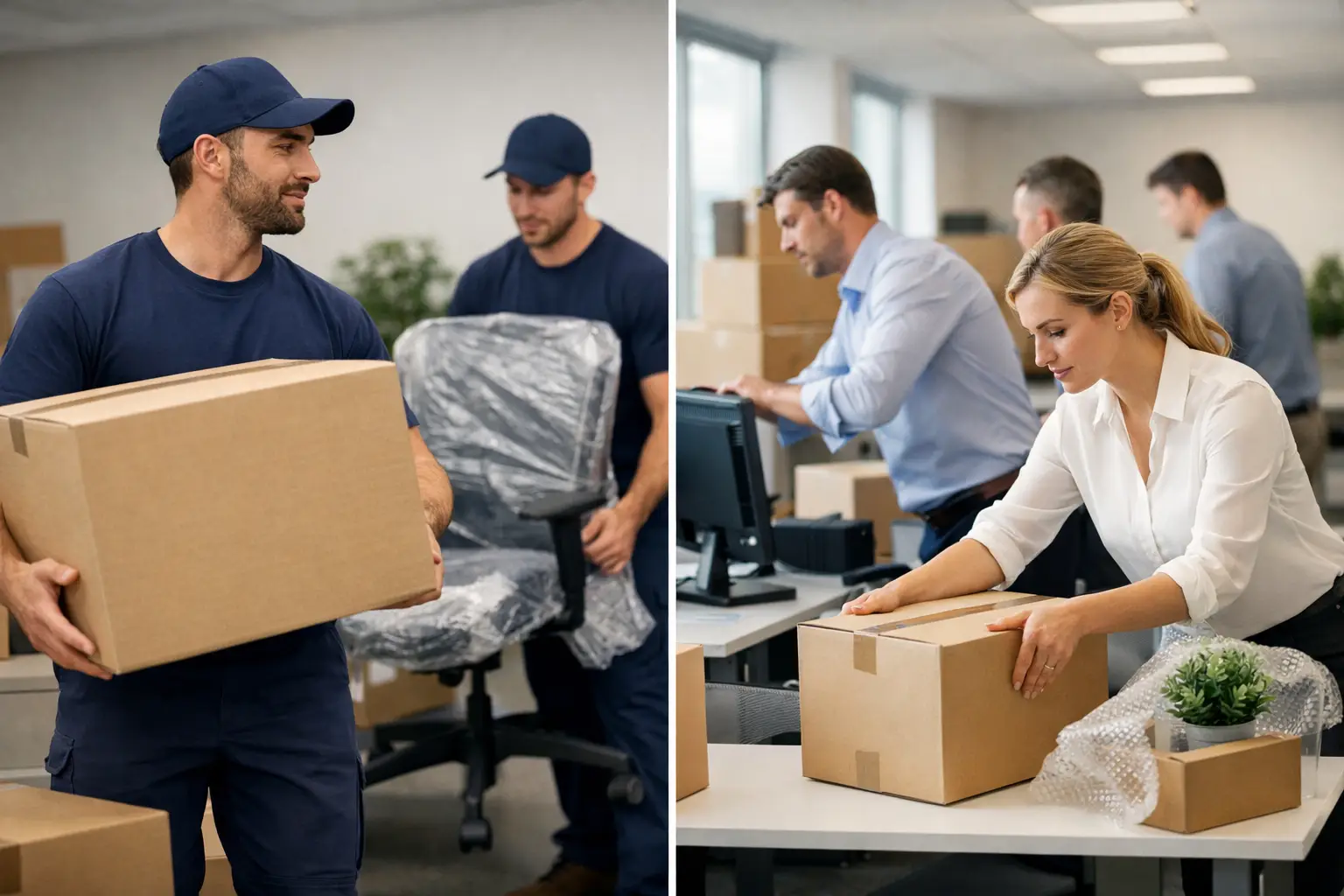
An office move can look simple on paper: pack desks, load a truck, set up at the new site. In practice, the choice between office movers vs internal staff can affect your operating hours, equipment safety, staff wellbeing and final cost. The cheapest option is not always the one with the lowest upfront price.
For a small business in Melbourne, the right approach depends on the size of the move, the furniture involved, the distance between sites and how much downtime your team can absorb. Internal staff may be useful for preparation and light tasks. Professional office movers are generally the safer choice when the move involves bulky furniture, IT equipment, access restrictions or a tight deadline.
The real cost of using internal staff
Using your own team can seem like an easy way to reduce removal costs. Your staff know the office layout, understand which files matter and can identify equipment that needs special attention. For a very small move, such as shifting a few desks within the same building, that familiarity has value.
But staff time is not free. Every hour spent dismantling desks, carrying boxes, waiting for lifts or driving between sites is an hour not spent serving customers, managing jobs or keeping the business running. If the move happens after hours or on a weekend, overtime and fatigue can add further cost.
There are also practical expenses many businesses miss at the planning stage. You may need a suitable truck, trolleys, furniture blankets, straps, packing materials, tools and protective covers. If a staff member damages a workstation, drops a monitor or injures themselves while lifting, the savings can disappear quickly.
The biggest hidden cost is often delayed reopening. A move that runs over by one day can mean lost sales, frustrated clients and a team unable to work properly. That is why the decision should be based on total business impact, not just the removal quote.
Why professional office movers reduce risk
Professional movers do more than provide a truck and labour. A trained crew works to a plan: protect floors and lift areas, dismantle furniture where needed, label and load items in a practical order, secure the load, then place furniture at the new office according to the agreed layout.
This matters when you are moving filing cabinets, boardroom tables, shelving, printers, workstations or fragile electronics. These items are awkward, heavy and easy to damage if handled without the right equipment or technique. They can also cause serious injuries when staff try to lift beyond their capability.
A reliable removalist brings the tools and procedures that make the job faster and safer. That can include furniture dollies, heavy-duty straps, padded blankets, protective wrapping and vehicles sized for the load. Professional handling also helps avoid damage to building foyers, lifts, door frames and common areas, which is especially relevant in Melbourne CBD offices with strict building management rules.
Insurance and accountability are another key difference. Before booking, confirm what cover applies, what the mover needs from you and how valuable equipment should be packed or declared. A professional provider should be clear about its process, pricing and responsibilities. Blaze Removals focuses on trained crews, insured services and practical support so businesses can move without putting the whole job on their own staff.
Office movers vs internal staff: compare the work, not just the price
The right choice becomes clearer when you separate the move into tasks. Internal staff are usually best placed to handle confidential documents, personal desk items, internal labelling and decisions about what stays, goes or is disposed of. They know what each department needs on day one.
Movers are best placed to manage the physical relocation. That includes dismantling and reassembling suitable furniture, packing bulky items, carrying loads safely, loading the truck efficiently and transporting everything securely. If you have a large photocopier, compactus unit, server rack, piano or other specialist item, ask about handling requirements before move day rather than assuming it can be lifted like standard furniture.
A combined approach often delivers the best result. Your staff prepare their own work areas and label boxes, while movers handle the lifting, transport and furniture placement. This keeps employees involved where their knowledge matters and removes the high-risk, time-consuming work from their workload.
Downtime is the deciding factor for most businesses
For customer-facing businesses, downtime is expensive. A clinic, retail office, agency, trades business or professional services firm may only have a narrow window to relocate without disrupting bookings, calls and revenue.
Professional movers can help compress the physical move into a planned timeframe. A crew can arrive with the right vehicle size and number of movers, rather than relying on staff availability and a borrowed ute. This is particularly useful when moving between offices with loading dock bookings, limited lift access or restricted parking.
Internal staff moves often take longer because people are fitting the work around their normal roles. Staff may also pack inconsistently, forget essential cables or leave sorting decisions until moving day. A good relocation plan avoids this by setting deadlines for packing, labelling and disposal before the truck arrives.
Do not overlook IT. Movers can safely transport labelled equipment, but your IT provider or internal tech lead should manage disconnection, data protection, server requirements and reconnection. Plan for internet activation at the new site well ahead of time. There is little benefit in having every desk installed by 10 am if no one can access the systems they need to work.
When internal staff can make sense
There are situations where using staff for all or part of the move is reasonable. It may work if you are relocating a small team within the same building, moving a handful of lightweight items, or shifting non-critical storage with no deadline pressure.
It can also suit businesses that have appropriate vehicles, trained staff, safe lifting practices and enough spare capacity to complete the work without affecting operations. Even then, it is worth assigning one person to coordinate the job. Without a clear point of contact, boxes go to the wrong rooms, furniture is left in corridors and small delays become a long day.
Internal staff should not be expected to move heavy cabinets, large desks or valuable equipment simply because they are available. Workplace safety duties still apply, and willingness does not equal training or safe manual-handling capability.
When hiring office movers is the practical call
Professional movers are usually the stronger option when the move involves more than a few light boxes. Hire a removalist when you need to move multiple rooms, travel between suburbs, work around building access rules or reopen quickly.
It is also the sensible choice if any of the following apply:
- Heavy, oversized or fragile furniture needs moving.
- The business has valuable IT equipment, archives or specialised machinery.
- Staff cannot be taken away from normal work without affecting clients.
- The move must happen after hours, over a weekend or within a fixed building booking.
- You need packing, dismantling, reassembly or disposal support.
The point is not that staff cannot help. It is that a business move needs the right people doing the right work. Your employees should be preparing for a productive first day in the new office, not spending it carrying filing cabinets down a stairwell.
Plan the move before requesting quotes
A detailed scope makes quotes more accurate and prevents surprises. Count workstations, meeting tables, chairs, filing cabinets, storage units, printers and boxed items. Note stairs, lift access, parking distances, loading dock rules and any items that need dismantling.
Decide what must be operational first at the new location. Reception, internet equipment, customer records and key workstations may need priority placement. Give the movers a simple floor plan and label furniture by room or zone. Clear labels save time at both ends of the move and reduce the chance of staff hunting through boxes on Monday morning.
Ask whether pricing is hourly or fixed, what number of movers and truck size are included, and whether packing materials, travel time, assembly or specialty-item handling are extra. Clear answers upfront are better than a low estimate followed by unexpected charges.
Choose the option that protects your people, your equipment and your operating time. A well-run office move is not about proving your team can carry everything themselves. It is about getting the business set up properly, safely and ready to work.